
2026 Election: Where Political Parties Stand on Ocean Matters
The Friends of Taputeranga Marine Reserve Trust has sent five questions to political parties to understand their positions on ocean matters.
The full responses are posted below, along with an explanation of the rating assigned to each response.
As at 27 October 2026, responses had been received from the National Party, Labour Party, Opportunity and Te Pāti Māori. The Green Party, ACT and New Zealand First had not provided responses.
We welcome additional responses before the election date on 7 November 2026. The Trust continues to engage with elected representatives across all parties to achieve better outcomes for the marine environment. We would also welcome the opportunity to discuss these questions in more detail with party representatives, particularly the definitions used to describe marine protection and fisheries management, and how the extent and effectiveness of protected areas are assessed.
Below are the full party responses.
Rating Criteria
- Neutral / no clear commitment: Does not clearly commit to the proposed change, indicates an uncertain position, or describes an approach that largely maintains the status quo.
- Partial support: Supports some aspects of the commitment, but important elements are missing, limited or fall short of the proposal.
- Support: Clearly supports the proposed commitment, even if details on implementation are limited.
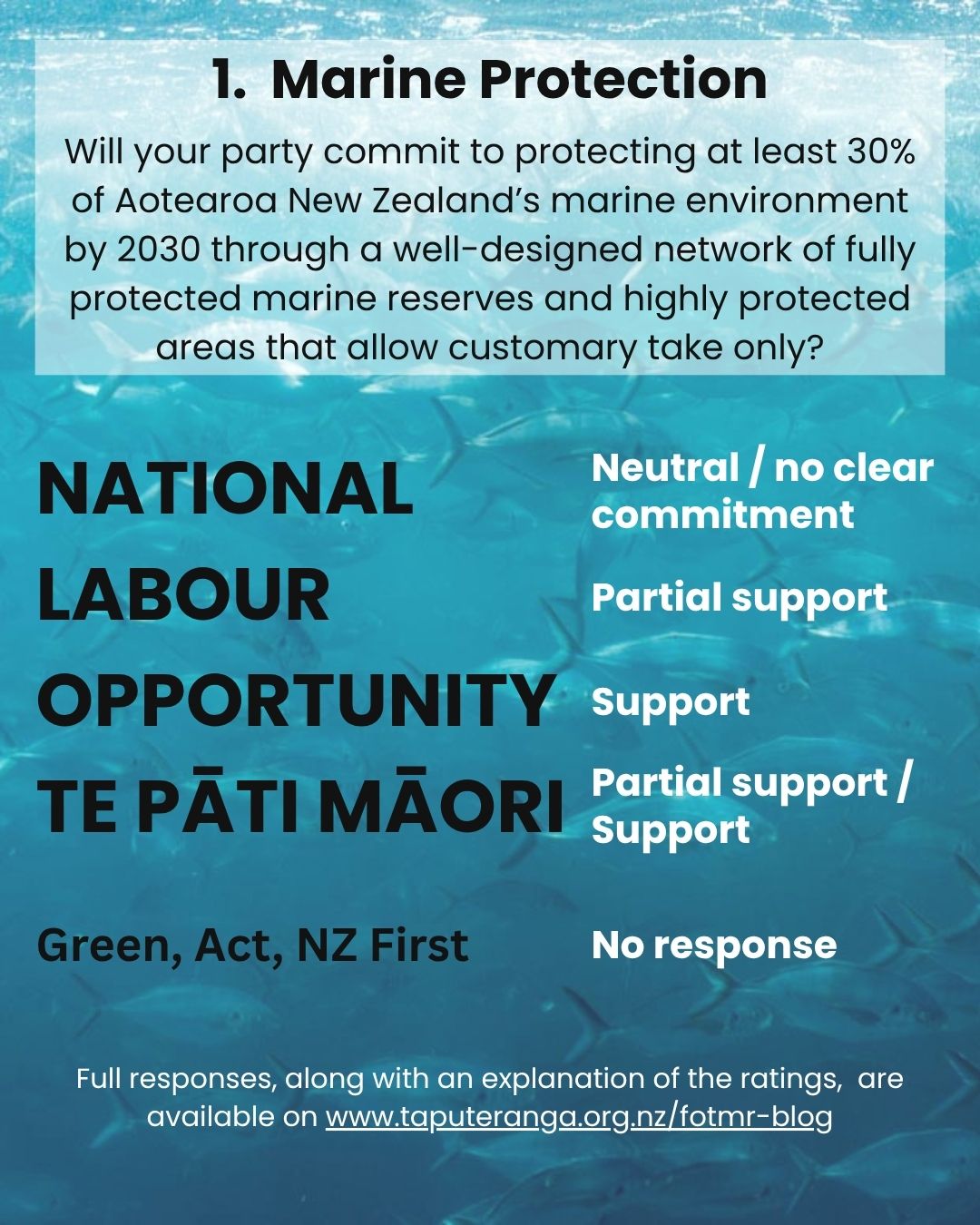
1) Marine Protection
Question: Will your party commit to protecting at least 30% of Aotearoa New Zealand’s marine environment by 2030 through a well-designed network of fully protected marine reserves and highly protected areas that allow customary take only?
National Party Response
National is committed to expanding protection of New Zealand’s EEZ, prioritising vulnerable seamounts and coral ecosystems increase protection of our EEZ from 32% to 50% by 2040. We’ll also establish the Hākaimangō-Matiatia Marine Reserve off Waiheke Island, a new 23.5 km² marine protected area in the Hauraki Gulf Marine Park and further expand the size of the Goat Island/Te Hāwere-a-Maki Marine Reserve. We’ve already established five new marine reserves off the coast of Otago, including habitats ranging from giant kelp forests and rocky reefs to offshore canyons and deepwater coral communities. This increased the area protected as marine reserves around mainland New Zealand by almost 50 per cent.
Rating: Neutral / no clear commitment
Trust Explanation: The response includes large areas of New Zealand’s EEZ that are minimally protected and still allow extensive extraction. Establishment of the Hākaimangō-Matiatia Marine Reserve off Waiheke Island and expanding Goat Island/Te Hāwere-a-Maki Marine Reserve are important conservation measures for the Hauraki Gulf Marine Park, but no information is provided on increasing effective protection outside the Hauraki Gulf.
Establishment of the Te Au Roa o Te Rakihouia marine reserves in Otago has taken over 10 years and proceeded under consecutive governments. Even including the newly established marine reserves, New Zealand is still protecting less than 1% of its EEZ in fully or highly protected areas.
Refer to the Marine Protection Atlas Guide for a definition of ‘minimally protected’ marine areas and an assessment of effective marine protection in New Zealand (as of 27 Oct 2026, this does not yet include the recently established reserves in Otago):
- MPA Guide Glossary: https://mpatlas.org/glossary/
- MPA Country Guide New Zealand: https://mpatlas.org/countries/NZL/
Labour Party Response
Labour will expand marine protected areas towards the 30 by 30 goal. Labour in Government will ratify the UN High Seas Treaty and support greater marine protections in the South Pacific and Tasman High Seas. Labour supports actions to improve sustainability, transparency, and public confidence in oceans and environmental policy.
Rating: Partial support
Trust Explanation: Some examples provided for the high seas. No details or framework provided for increasing protection of representative habitats in coastal waters.
Opportunity Response
Opportunity is committed to protecting 20% of Aotearoa New Zealand’s ocean territory by 2030 and 30% by 2035. We would reform the Marine Reserves Act 1971 to enable a comprehensive, representative network of marine protected areas, developed in partnership with mana whenua, scientists, coastal communities and other stakeholders.
Protection would prioritise threatened species, vulnerable seabed habitats, spawning and nursery grounds, and ecological connectivity. We would use fully protected marine reserves and highly protected areas, respecting Te Tiriti obligations and customary rights.
Progress would be measured through independently monitored indicators, including habitat condition, fish abundance and size, biodiversity and threatened-species recovery. We would report not only the area protected, but whether protection is delivering measurable ecological benefits.
Rating: Support
Te Pāti Māori Response
Our submission on fisheries reform underscores Te Pāti Māori’s commitment to kaitiakitanga and protections across our rohe moana, including provision for mātaitai reserves. That submission can be found here: Te Pāti Māori Submission on the Fisheries Amendment Bill (link to pdf).
Te Pāti Māori will work in partnership with mana whenua, the sector, local government, and authorities to co-design how ecological benefits can be measured.
Rating: Partial support / Support
Trust Explanation: Te Pāti Māori answered “Yes” to the proposed commitment and refers to kaitiakitanga, protection across rohe moana, and mātaitai reserves. However, the answer does not provide more specific details on how 30% marine protection through a network of fully and highly protected areas would be achieved by 2030.
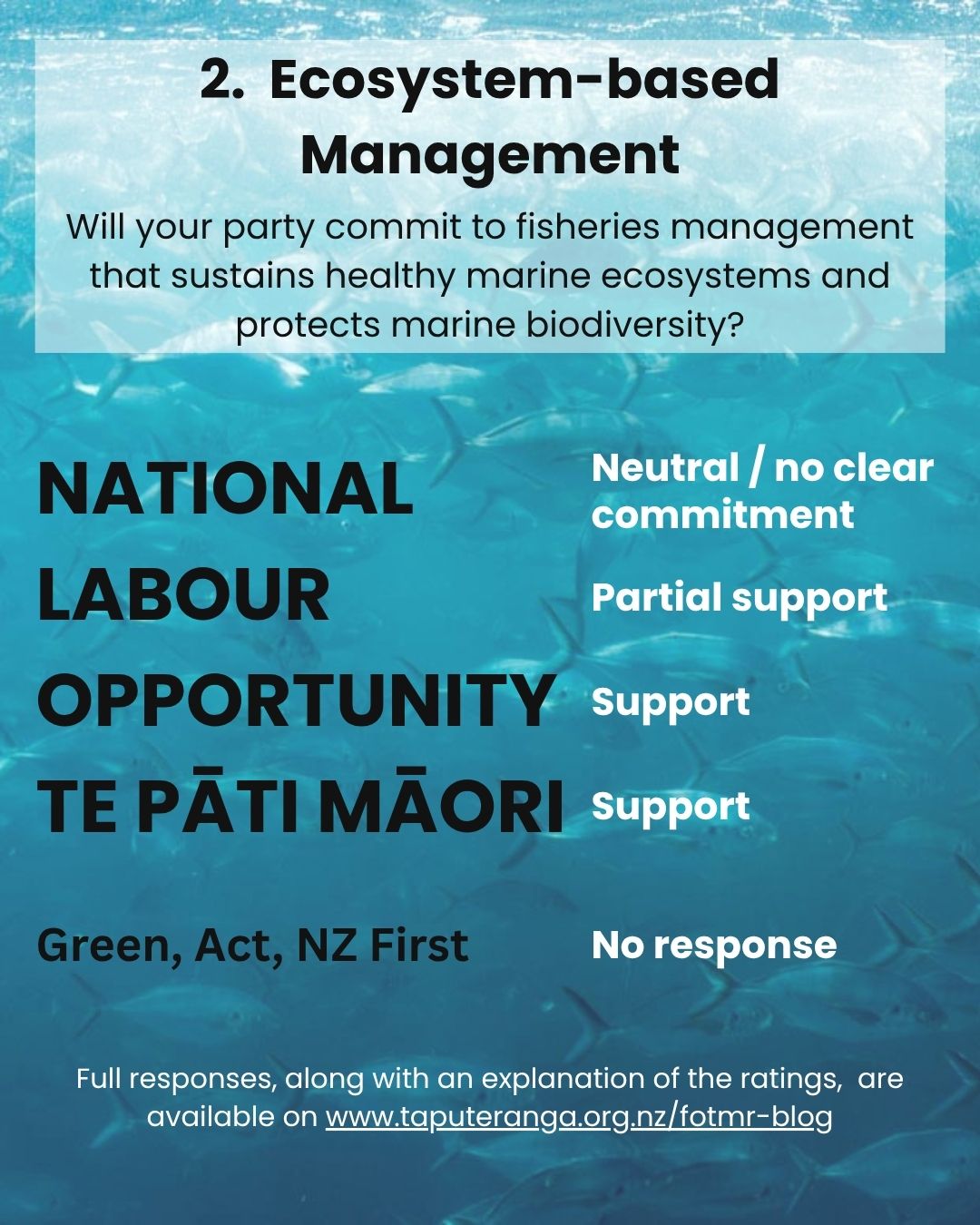
2) Ecosystem-based Management
Question: Will your party commit to fisheries management that sustains healthy marine ecosystems and protects marine biodiversity?
National Party Response
We want fish stocks managed at healthy and abundant levels, not simply kept above minimum sustainability limits. Our decisions will be guided by the best available science, data and evidence, while upholding property rights and the Crown’s Treaty settlement obligations.
We will review bottom trawling in the Hauraki gulf, increase protection of New Zealand’s EEZ from 32% to 50% by 2040, and develop a sustainable fisheries plan for the wider Gulf Marine Park.
A re-elected National Government will establish a $20 million Fish Tech Innovation Fund in partnership with the seafood sector. This Fund will be targeted towards better fishing gear and practices, supporting research and innovation that reduces seabed contact, reduces the impact of bottom trawling and protects sensitive habitats, alongside better biomass data. We will also keep the ban on harvesting from rockpools to help these ecosystems recover, and work to improve fisheries data so pressures are identified earlier.
Rating: Neutral / no clear commitment
Trust Explanation: No commitment to shift to ecosystem-based managment across NZ. No commitment to phase out bottom trawling (the commitment is to review bottom trawling in the Hauraki Gulf only).
Not enough information provided how the investment in the Fish Tech Innovation Fund will effectively protect biodiversity or support ecosystem-based management.
We commend the National Party’s ambition to improve fisheries data.
Labour Party Response
Labour believes in a healthy, thriving ocean that ensures its precious ecosystem are protected. Labour will take an ecosystem approach to fisheries management and supports a science-based approach that ensures abundant and healthy fish stocks for future generations.
Labour supports a ban on seabed mining in Aotearoa. Labour believes in a healthy, thriving ocean that ensures its precious ecosystem is protected. Labour has previously spoken out against seabed mining. We launched a Select Committee inquiry into seabed mining during our time in government, and this was thrown out by the National-led government. Labour will amend the necessary legislation and associated regulations, such as the Exclusive Economic Zone and Continental Shelf (Environmental Effects) Act 2012 (EEZ Act). We will also amend National’s replacements to the RMA and Fast Track legislation to ensure environmental protection is at the heart of these Acts.
Labour will stop new areas of bottom trawling on seamounts and other vulnerable ecosystems.
Rating: Partial support
Trust Explanation: Commitment to stop seabed mining. Commitment to amend RMA and Fast Track legislation.
Clarification needed on what taking an ecosystem approach to fisheries management practically means and what stopping bottom trawling in ‘new’ areas means in comparison to current trawling areas and trawling practices.
Opportunity Response
Opportunity would shift fisheries management towards ecosystem-based approaches that restore abundance and protect marine biodiversity.
We would reform the Quota Management System to account for ecosystem health and cumulative environmental impacts, raise the target for sustainable stocks from 40% to 50% of virgin biomass, and strengthen soft and hard limits to prevent depletion.
We would require cameras on commercial fishing vessels, improve public access to fisheries data and strengthen compliance to reduce bycatch and improve accountability.
We would phase out bottom-impacting fishing methods (including bottom trawling, dredging and Danish seining) as follows:
- Immediate closures in the Hauraki Gulf and other inshore areas facing critical decline.
- A three-year phase-out on all seamounts, including those on the High Seas.
- A five-year phase-out on other deep-sea features, including cold-water coral and vulnerable benthic habitats.
The phase out will include transition assistance for affected operators and workers: support to retrain, retool for alternative fishing methods, or to exit the industry with dignity. We will also back value-add innovation, sustainable and land-based aquaculture, and blue economy growth to create new high-value jobs.
Rating: Support
Te Pāti Māori Response
Te Pāti Māori is wholeheartedly committed to sustainability of healthy marine ecosystems and marine biodiversity.
Te Pāti Māori co-leader Debbie Ngārewa-Packer has advocated fiercely against seabed mining in South Taranaki in defence of healthy marine ecosystems. We refer to our submission on fisheries reform (link to pdf).
Rating: Support
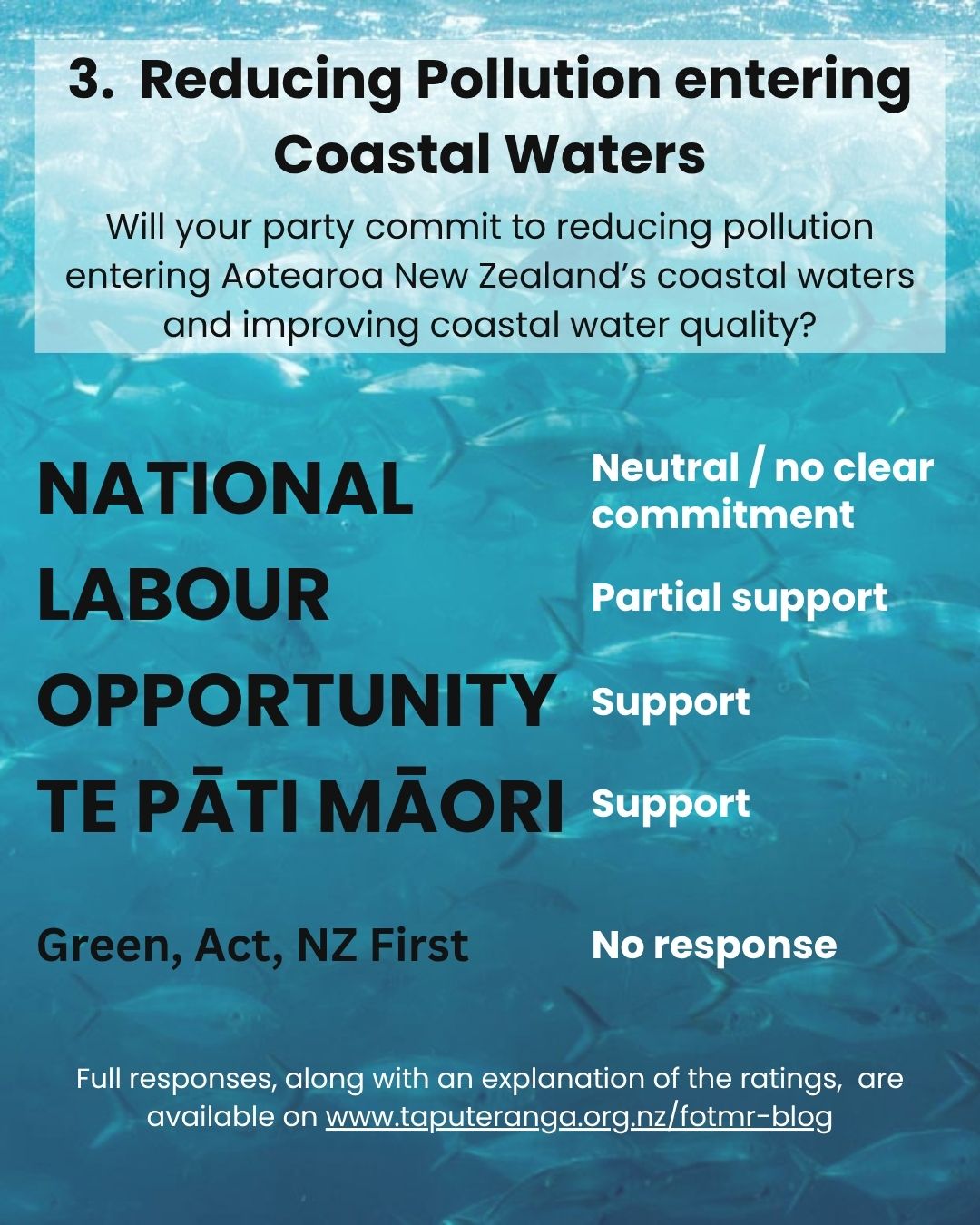
3) Reducing Pollution entering Coastal Waters
Question: Will your party commit to reducing pollution entering Aotearoa New Zealand’s coastal waters and improving coastal water quality?
National Party Response
National are focused on practical conservation outcomes. The health of our ocean matters to every New Zealander. It is part of who we are, provides us food, recreation, well-being, and a place for families and communities to connect. Recreational fishing generates around $1.7 billion of economic activity per year, the seafood industry’s economic output is around $6.4 billion per year, and the annual worth of the boating and marine industry is around $3 billion.
We’ve increased the area protected as marine reserves around mainland New Zealand by almost 50 per cent. Alongside record investment in biodiversity, stronger predator control, and work to improve the health of our oceans and waterways, these reserves are another important step in building a stronger future for nature.
Rating: Neutral / no clear commitment
Trust Explanation: Response does not address the question. Fully and highly protected marine areas still make up less than 1% of New Zealand’s ocean area.
Labour Party Response
The health of water is in the best interests of current and future generations.
Labour supports ways to reduce pollution entering waterways. Labour had an amendment to the Government’s Planning Bill would have required the consideration of the polluter pays principle. This gives an indication of the actions Labour would take in government.
In addition, Labour’s view is that for New Zealand’s environment to be protected and managed there needs to be an integrated approach that considers issues such as sediment runoff from both rural and urban environments into our rivers and coastal environment.
Rating: Partial support
Trust Explanation: Response recognises issues such as sediment runoff.
Opportunity Response
Opportunity would establish a nationally coordinated coastal water-quality programme, with measurable targets, clear responsibilities and annual public reporting.
We would prioritise investment in wastewater infrastructure to reduce sewage overflows and untreated discharges, targeting upgrades according to environmental damage and public-health risk. We would improve stormwater management through green infrastructure, wetlands and rain gardens, and reduce sediment and nutrient runoff through stronger erosion controls, riparian planting and wetland restoration.
We would also advance a circular plastics economy, including a national container deposit scheme, to reduce waste entering waterways and the ocean.
Within the first parliamentary term, we would establish baseline measurements, identify priority catchments and set time-bound reduction targets in consultation with councils, mana whenua, scientists and communities. Monitoring would cover microbial contamination, nutrients, sediment and litter, alongside coastal ecosystem health. We would prioritise pollution prevention and ensure polluters bear an appropriate share of remediation costs.
Rating: Support
Te Pāti Māori Response
Te Pāti Māori’s freshwater policy (link to pdf) sets out a number of policy commitments grounded in kaitiakitanga and rangatiratanga. Our starting position is that water is a tāonga protected under Article 2 of Te Tiriti o Waitangi and that the government has an obligation to protect tāonga. Te Pāti Māori will work with a broad range of groups to plan for the strategic inheritance our mokopuna deserve.
Rating: Support
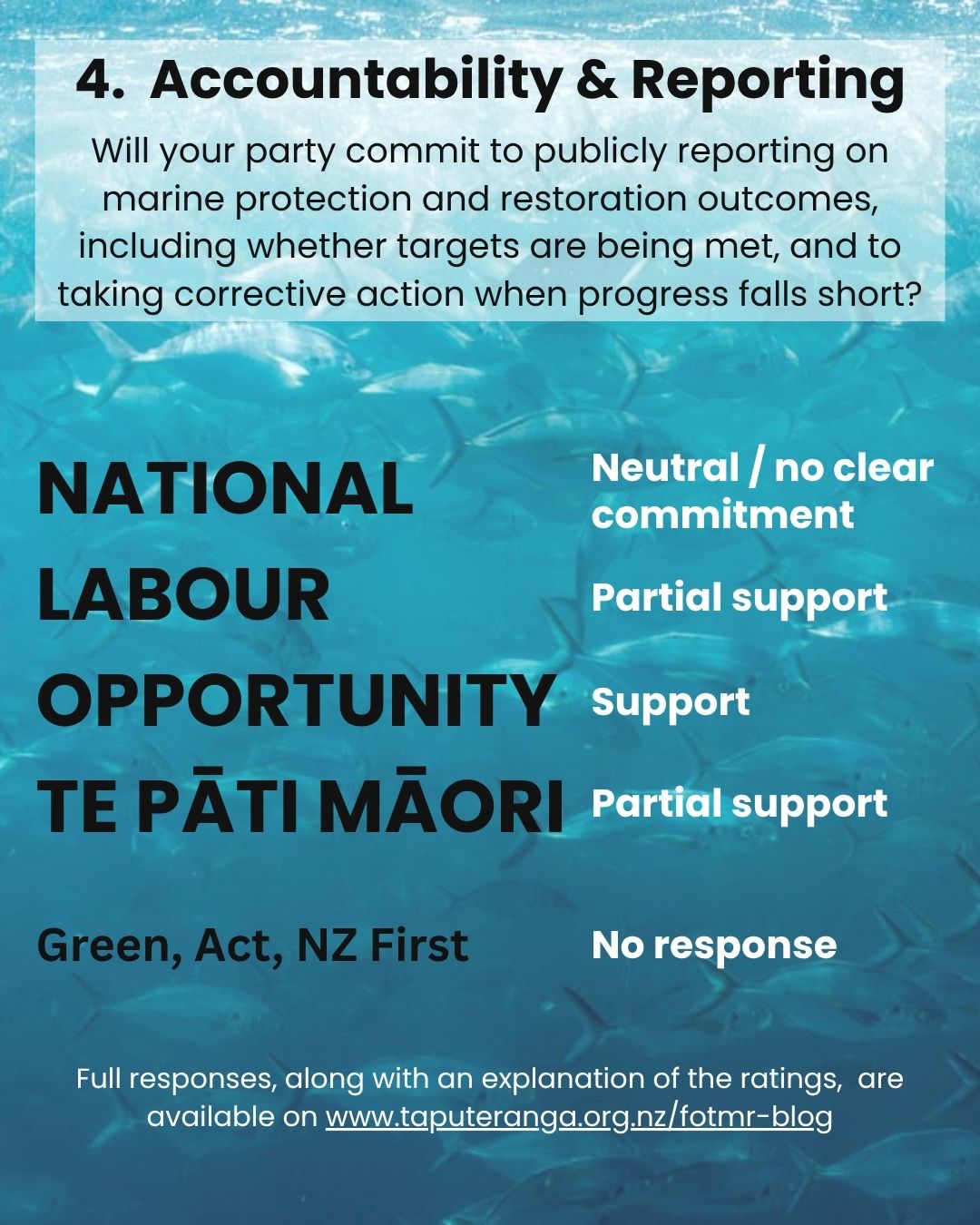
4) Accountability and publicly reporting on marine protection and restoration outcomes
Question: Will your party commit to publicly reporting on marine protection and restoration outcomes, including whether targets are being met, and to taking corrective action when progress falls short?
National Party Response
National believes transparent, reliable data is essential to public confidence in how our fisheries and marine environment are managed. We will work with the wider fishing sector to improve fisheries data, so that emerging stock pressures are identified earlier and management responses occur sooner. Our Fish Tech Innovation Fund will invest in biomass research to make the Quota Management System more responsive.
Our approach keeps the flexibility to review settings as scientific understanding, environmental conditions and fisheries change.
Rating: Neutral / no clear commitment
Trust Explanation: No reference to ecological outcomes.
Labour Party Response
Labour believes that any regulatory system and environmental laws should be accompanied with good and efficient ways of compliance, monitoring, and enforcement. Labour is committed to ensuring there is appropriate transparency and accountability measures for environmental and marine protection.
Rating: Partial support
Trust Explanation: Response expresses commitment to transparency and accountability measures, but no particular action.
Opportunity Response
Opportunity supports transparent, evidence-based management of our marine environment, including full transparency and accountability for commercial fishing operations.
We would introduce an annual public marine health scorecard tracking progress against national objectives for marine protection, fisheries sustainability, biodiversity, coastal water quality and restoration.
Independent scientific monitoring would assess ecological outcomes, including fish stock abundance, seabed condition, threatened-species recovery and water quality. Open access to marine research and relevant fisheries data would enable public scrutiny.
Agencies would have clearly defined responsibilities and milestones, with progress reported publicly. Where targets were missed or ecosystems continued to decline, responsible agencies would be required to explain the shortfall and develop time-bound corrective action
plans. These could include stronger fishing restrictions, revised catch limits, additional habitat protection or targeted restoration.
Opportunity considers the success of marine protection must be judged by measurable improvements in ocean health, not simply the footprint of an area designated on a map.
Rating: Support
Te Pāti Māori Response
We are open to bringing greater monitoring, reporting, and accountability over the current system. We opposed recent resource management reform under this government, taking umbrage with the government’s proposals to weaken environmental protections, including across the marine and coastal areas. Our submission on resource management reform can be found here: Te Pāti Māori Submission on the Planning Bill and Natural Environment Bill (pdf).
Rating: Partial support
Trust Explanation: Response states support for greater monitoring, reporting and accountability, and opposes resource management reforms that would weaken environmental protections. However, the response does not specify commitments to publicly report on marine protection and restoration outcomes, assess progress against targets, or take corrective action when progress falls short.
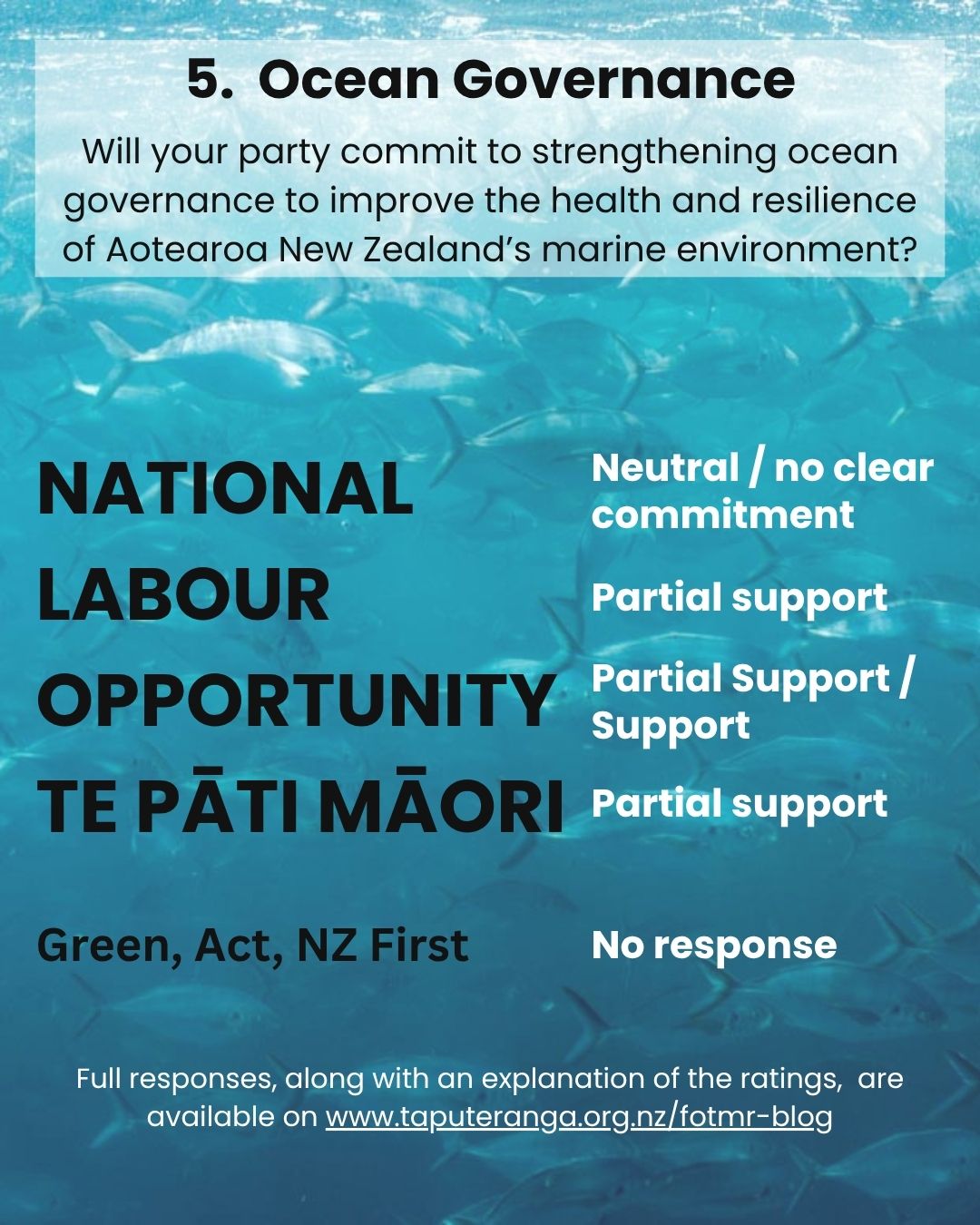
5) Ocean Governance
Question: Will your party commit to strengthening ocean governance to improve the health and resilience of Aotearoa New Zealand’s marine environment?
National Party Response
It is important for Government to work closely with Iwi, coastal communities, industry and recreational fishers, to preserve the long term health of our oceans and the sustainability of our fishing sector.
National recognises the Hauraki Gulf’s importance to mana whenua, and will uphold the Crown’s Treaty fisheries settlement obligations, alongside property rights. That’s why we passed the Hauraki Gulf / Tīkapa Moana Marine Protection Act 2025, recognizing this importance. We believe customary, recreational and commercial interests must be balanced in a way that protects the marine environment for future generations.
Rating: Neutral / no clear commitment
Trust Explanation: No reference to areas outside the Hauraki Gulf.
Labour Party Response
Labour supports use of the environment where Te Oranga o te Taiao (the wellbeing of the natural environment) is upheld. This includes goals of:
- biodiversity being protected and restored on land, in freshwater, wetlands, estuaries, and in the ocean,
- clean water that allows Kiwis to engage in recreational activities in the ocean free from harmful pollution and,
- oceans have long term health and resilience, including fisheries.
Labour supports ongoing reform of fisheries management to improve sustainability, transparency, and public confidence in the system. We recognise Treaty obligations and the importance of Māori participation in fisheries management. Future policy settings should ensure fisheries resources are managed for long-term abundance and deliver benefits to all New Zealanders while honouring settlement commitments and partnership obligations under Te Tiriti o Waitangi.
Rating: Partial support
Trust Explanation: Response expresses commitment, but no particular pathway to a strong governance framework.
Opportunity Response
Opportunity would strengthen integrated ocean governance by restoring the Oceans Secretariat to improve coordination across government agencies and align decisions on fisheries, conservation, pollution, climate resilience and sustainable economic development.
We support integrated marine planning that considers biodiversity, customary use, coastal communities and economic activity together, with clear national objectives and measurable outcomes.
Our approach would uphold Te Tiriti o Waitangi, respect customary rights and enable meaningful participation by mana whenua. We would support iwi- and hapū-led initiatives and ensure coastal communities, fishers, local government, scientists and conservation organisations can contribute to decisions affecting their marine environments.
We would strengthen access to marine research and introduce consistent monitoring and annual public reporting against national marine protection, fisheries sustainability and restoration objectives. The Oceans Secretariat would help coordinate implementation and track progress across agencies.
Success would be measured through ecological indicators, including fish-stock recovery, habitat condition and water quality. Healthy oceans are essential national infrastructure, underpinning biodiversity, food security, coastal livelihoods and a resilient blue economy.
Rating: Partial support / Support
Trust Explanation: The response refers to restoring an Ocean Secretariat to coordinate across government agencies. However, it is unclear how coordination without a strong mandate will achieve the intended outcomes.
Te Pāti Māori Response
Te Pāti Māori supports strengthening ocean governance in Aotearoa and across the Pacific. We are open to greater accountability across the system. As above, our submissions on fisheries and resource management reforms underscore our commitment to our marine and coastal areas grounded in kaitiakitanga and rangatiratanga.
We will restore Supreme Court awarded rights of mana whenua that were hard-fought for and then erased by the recent Marine and Coastal Area (Takutai Moana) Amendment Act under this government.
Rating: Partial support
Trust Explanation: Response expresses commitment, but no particular pathway to a strong governance framework.