
The latest from Lisa Wolf – 2023 scholarship recipient
More than just a place to live: Exploring the benefits of the sea anemone–seaweed symbiosis
In my previous blog post in 2023, I introduced the fascinating relationship between the brooding sea anemone Handactis nutrix and its seaweed hosts along Wellington’s south coast. My earlier research suggested that the anemones may provide their hosts with a source of nitrogen, a nutrient essential for seaweed growth. But does this actually benefit the seaweed, and what does the anemone gain from living on its host?
With the support of the Kevin Smith Memorial Scholarship, I have continued exploring these questions as part of my PhD research at Victoria University of Wellington.
What happens when the partners are separated?
To investigate how the two organisms influence each other’s growth and health, I conducted a 16-week experiment spanning autumn and winter. I collected the native brown seaweed Cystophora scalaris, commonly known as ladder weed, and its associated sea anemones Handactis nutrix, commonly known as the brooding anemone, from Waitaha Cove and created three experimental groups: (1) eight seaweeds that retained their anemones (15 anemones per seaweed), (2) eight seaweeds from which the anemones were carefully removed, and (3) the removed anemones, which were maintained separately without their seaweed hosts as an anemone-only control (15 anemones per tank).
At the beginning and end of the experiment, I measured the biomass and size of both partners, the anemones’ respiration and the seaweeds’ photosynthetic activity and pigment concentrations. I also analysed tissue samples from both partners to investigate carbon and nitrogen stable isotope ratios and elemental compositions. Throughout the experiment, I documented any mortality, the anemone’s brooding activity, and collected seawater samples every two weeks to monitor nutrient concentrations in the experimental seawater system. During the latter half of the experiment, I also measured seaweed blade loss.
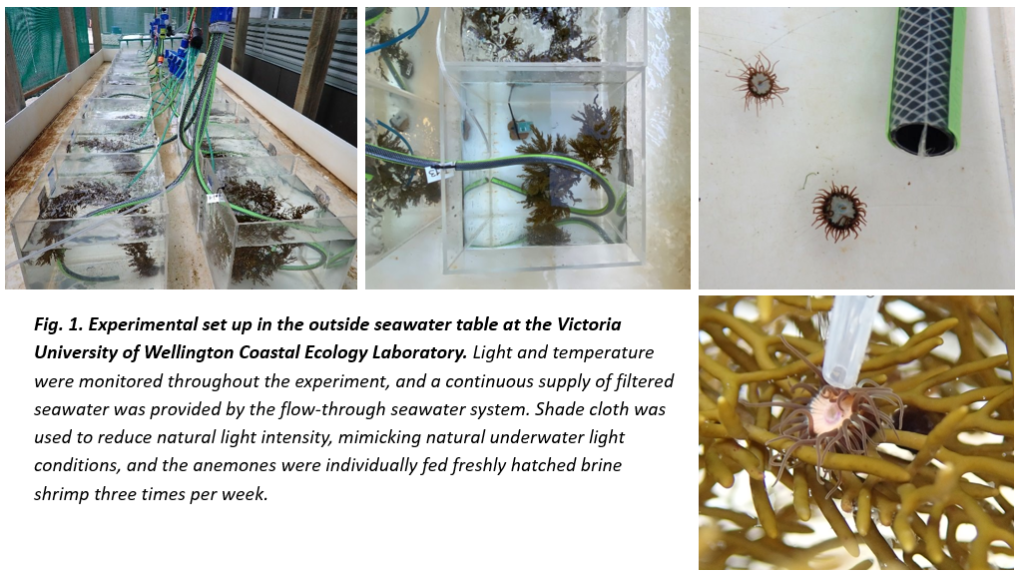
A small anemone with a big impact?
One of the most exciting findings was that seaweeds retaining their anemones maintained their biomass, gaining around 2% on average. In contrast, seaweeds from which the anemones had been removed lost approximately 15% of their biomass over the same period. During the latter half of the experiment, seaweeds without anemones also lost blade tissue at approximately twice the rate of those with anemones. This suggests that the presence of anemones may help their hosts retain tissue and maintain their biomass.
Interestingly, net photosynthesis increased by approximately 39% in seaweeds retaining their anemones over the experiment, whereas it remained almost unchanged (1% increase) in seaweeds from which the anemones had been removed. Although this difference suggests a potential trend, the differences were not statistically significant. However, the seaweeds’ nitrogen isotope ratios changed differently between treatments over time, suggesting that anemone presence may influence the source of nitrogen used by the seaweeds.
One possible explanation is local nutrient recycling. Sea anemones release nitrogenous waste, in form of ammonium, which seaweeds can take up and use for growth and photosynthesis. My earlier research provided evidence for this transfer, and the findings of this experiment suggest that such local nutrient recycling may contribute to the maintenance of seaweed biomass.
The benefits go both ways
The seaweeds were not the only organisms that appeared to benefit from the partnership. Anemones that remained attached to their hosts gained approximately 17% in body mass, while those that had been removed lost around 26%. Respiration rates also decreased by approximately 37% in host-associated anemones over the experiment, compared with around 10% in anemones maintained without their seaweed hosts. Together, these findings suggest that remaining associated with the seaweed may provide a more favourable balance between energy gained and energy used by the anemones. Interestingly, 15 of the 16 observations of brooding during the experiment occurred among anemones that remained associated with their seaweed hosts. Brooding is a reproductive process in which the anemones carry developing offspring within their brood pouch.
Together, these findings suggest that the relationship may be mutually beneficial, helping seaweeds maintain their biomass while supporting anemone growth and influencing their brooding activity.
Taking the research back into the field
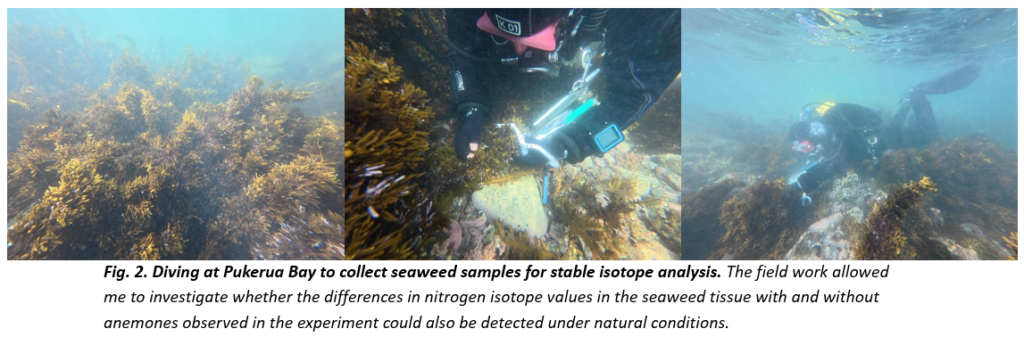
To explore whether similar nutritional patterns could be observed in nature, I also collected samples of Cystophora sp. from Pukerua Bay, north of Wellington. Here, I compared seaweeds naturally hosting anemones (minimum of 15 anemones per seaweed) with those without anemones.
Using stable isotope analysis, I examined whether the presence of anemones was associated with differences in the seaweeds’ carbon and nitrogen isotope ratios. Although the seaweeds showed some differences in their nitrogen and carbon isotope values, these were not statistically significant. Interestingly, the nitrogen isotope values showed a similar pattern to that observed at the end of the experiment, with lower average δ15N values in seaweeds hosting anemones. However, such differences may be more difficult to detect under natural conditions, where environmental factors such as nutrient availability, water movement and seasonal changes can also influence the seaweeds nitrogen sources and uptake.
Together with my experimental findings, these field observations highlight the complexity of interactions between marine organisms and their environment.
Why does this relationship matter?
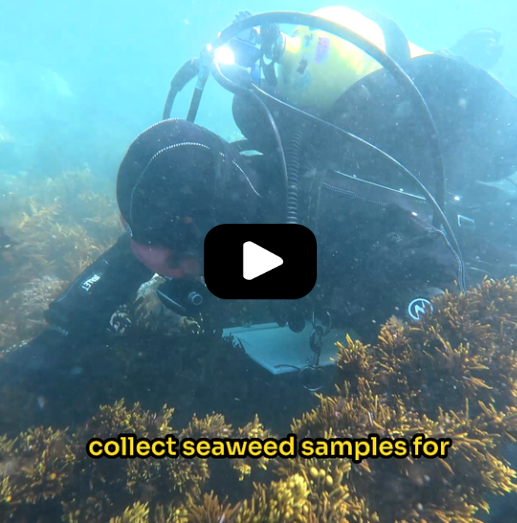
Watch a short video about Lisa’s work here – video supplied.
Seaweed beds provide important habitats for many marine organisms along New Zealand’s coastlines. They offer food, shelter and habitat, making them an important part of our coastal ecosystems.
Understanding how seaweeds interact with the small animals living on them may help us better understand the processes supporting these habitats. My findings suggest that the association with the brooding anemone could influence the growth and tissue maintenance of its much larger seaweed host. Such interactions may be particularly important when nutrient in the surroundings seawater are low, although this remains to be investigated.
Although there is still much to learn about the mechanisms behind this relationship, my research highlights the importance of studying the small organisms living on seaweeds and the close relationships, including symbioses, that they may form.
I am very grateful for the support of the Kevin Smith Memorial Scholarship and the Friends of Taputeranga Marine Reserve Trust, which have helped me continue investigating this fascinating relationship.
If you’d like to make a difference and support our scholarships, and community education and outreach events in Taputeranga Marine Reserve, please consider a donation to the Friends of Taputeranga Marine Reserve Trust.
Photos and text by Lisa Wolf
Photos Pukerua Bay: Dr. Valerio Micaroni
Video editing: Lisa Wolf and Dr. Ilya Shabanov